Pages

Sunday, May 28, 2017

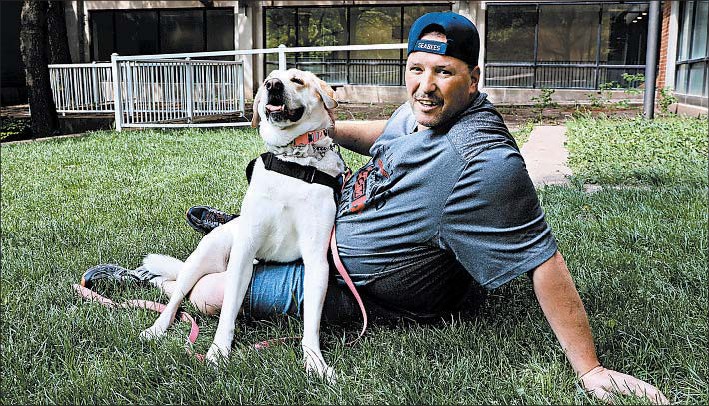
Service Dogs Help Vets With PTSD


Antonio Perez/Chicago Tribune Photos

Many vets returning from combat have difficulties coping with what they experienced.  Unfortunately, there is still a great deal of shame associated with seeking mental health services in the military. This prevents numerous vets from seeking the help they need leading to untold suffering and poor quality of life.  This is especially troubling given that we have a new generation of combat vets, the first to be engaged in a long-term conflict since the end of the Vietnam War in 1975, who may be silently hurting.

With the end of Iraq war, our veterans returned to an appreciative country, and while they may have survived physically, they may not have fully done so psychologically.  For some of these vets, reconnecting with their small children may be a problem since in Iraq if they saw a mother and child their first thought involved whether she was carrying explosives.  Some may be experiencing survivor guilt, unable to understand why others were killed and not them, or anger at what they had been forced to do.  Some vets can’t reconnect to friends since they saw too many peers killed and don’t want to experience the pain of losing someone else they care about.  Some can’t reconnect to anyone because they feel that while others may care, none of them can know or relate o what they encountered during the war. For many of these, such problems are just one part of a much larger picture.
Of those vets who fought in Operation Enduring Freedom or Operation Iraqi Freedom, it has been estimated that 25 percent are suffering from PTSD.  This has also been said to be a gross underestimate, as it’s recognized that numerous vets who experience mental health problems do not seek help.  Even many of those diagnosed with PTSD do not follow through on recommended treatment.  In fact, it has been determined that as many as 60 percent of those identified as suffering from PTSD do not begin recommended therapy or drop out soon after beginning therapy.  This amounts to a huge number of our vets who are in pain and not getting the help they need.
K-9 for Veteran Warriors, a Chicago based organization, recognizes that many vets with mental health difficulties don’t pursue therapy or feel that it doesn’t always help with all the problems soon enough to prevent premature termination.  They have begun a program which matches specially trained dogs they get from no kill shelters with veterans suffering from PTSD.  The program takes into account the vets lifestyle including whether they live in an apartment or house, in town or a rural area  how active they are.

The dogs are selected in part because a calm and eager to learn temperament.  They are also chosen because they show evidence of empathy.  These amazing animals actually sense when the vet is beginning to experiencing anxiety and do things to help decrease it.  One vet who has been matched with one of these animals, an Iraqi war veteran who served in the Navy for 7 years before joining the Illinois National Guard which was deployed to Iraq, says the dog he was given has changed his life.  

When he talks about his war experiences in group therapy, the dog stands protectively nearby.  He says that she also prevents him from self-isolating since he has to walk her and that she has made it possible for him to go into crowded places again when she is with him.  When feeling the stress of heavy traffic the dog puts her head on his shoulder.  His wife is also thankful to the dog for helping her husband begin taking care of himself as the result of the responsibility of taking care of her needs.  “We’ve got an adorable little blonde at home that I don’t have to worry about,” his wife said.

The vet also credits the free three week intensive program at the Center for Veterans and Their Families at Rush University Medical Center in Chicago, with helping decrease his problems related to the war.  But he added that nothing helped more that the energetic golden retriever/mastiff mix with whom he was gifted.

Those interested in these programs can find out more through the links below.

K-9 for Veteran Warriors - The mission of the program is to place service dogs to help veterans cope with PTSD so they can live happy and productive lives after their military career ends. They also provide free food and medical care for the life of the dog.

The Road Home Program, Rush Medical University -  The Intensive Outpatient Program (IOP) is a full-spectrum, three-week treatment program that connects veterans to individualized care for trauma-based disorders and injury.  The program is open to all veterans of any era.  Veterans need not live in Chicago to apply.  Food, lodging and travel expenses for veterans and one family member or significant other will be provided. In some circumstances, the program may be able to help cover other expenses incurred during the three week stay.



Tuesday, May 23, 2017

The Psychology of Party Politics and Impeachment


Consider the current question of the contact between Russia and the Trump campaign. We know there was contact and we even know that sensitive information was discussed, as in the sanctions put in place by Obama against the Russians. We know the Russians, by their own admission, sought to get Trump elected over Clinton. We currently have no absolute evidence of collusion between the Trump campaign and Russia as far as interfering in the election.

But, what if there was in fact collusion?  What if the current President did conspire with a foreign power in order to become elected president? And not just any foreign power but a foreign power with nuclear missiles aimed at us 24 hours a day since the 1950's. If collusion, was proven how hard would it actually be to impeach  the ?  It would, by all accounts, be extremely difficult to do and would certainly cause horrendous disruption in the country but treason is treason.  


Yet, even with evidence, why do most say it would be nearly impossible to even start the impeachment ball rolling?  The answer is clearly seen every time there is a State of the Union Address.  Ever notice there is something odd about the frequent standing ovations the President always receives?  Specifically, I refer to how most of the standing ovations of the night include only one half of the room or the other.  When the President says something that the Republicans back, the half of the room comprised of Republicans gets to their feet while the other half of the room applauds politely.  When a comment that is supported by the Democrats is made this outcome reverses.  No one really believes that there would a motion or proposal that 100% of the Republicans and 0% of the Democrats support or vice versa, such that this can only reflect party politics.  

The same thing applies to impeachment.  The United States constitution sets up strict requirements for removal of a sitting president for transgressions of “treason, bribery, or other high crimes and misdemeanors.”  It requires, however, that both the House and two-thirds of the Senate must vote in favor of impeachment.  Given that impeachment is a political act and the Constitution does not set down any specifics as to under what conditions a President must be removed from office, Impeachment remains in the hands of Congress.  Congress is unlikely to act unless they decide it is in their best interests.  As the Republican Party controls both the House and Senate, they are highly unlikely to try to impeach their own President as it would only hurt them and the Republican Party to do so, also likely ensuring the winner of the next election will be a Democrat.    

For this to happen, several conditions would have to be present. There would need to be solid, irrefutable proof of criminal wrongdoing by the president. This proof would have to be so undeniable that the support Trump currently has would turn against him, making it impossible for the Republicans to fail to impeach him.  Essentially, the Republicans would have to perceive Trump’s continued presidency to be more harmful to them than his removal would be.  At this point there is nothing that approaches this criteria.  Additionally, Trump’s approval ratings would have to be extremely low, before the Republicans began to perceive impeachment they have a mandate for impeachment. Yet with the recent firing of the FBI director and Trump’s approval ratings dropping off significantly, impeachment may be becoming increasingly likely.

This is exactly what Alexander Hamilton was concerned about in Federalist Paper # 65.  In this paper, Hamilton acknowledges that having a political body be the ones to act as a court regarding impeachment proceedings is less than ideal.  He argued this due to the fact that in a bipartisan system, the body responsible for impeachment proceedings would have a majority of one party or the other.  Thus, the decision of whether to prosecute the President would likely be politically based not based on justice.  

While Hamilton recognized that any Government would have small imperfections in terms of handling every problematic situation that arose, it appears that the system of impeaching a President is more than a small imperfection.  It seems that when Congress and the President have the same party affiliation there is practically nothing the President can do that will result in impeachment while when party affiliation differs impeachment proceedings might be attempted to embarrass the other party or get the President out of office despite no true wrongdoing.  This means impeachment has become a weapon to use by Congress against a President of a different political party or as a means of protection allowing a President to stretch the limits of Constitutional authority without repercussion.

Tuesday, May 9, 2017

New Study Shows Cannabis Reverses Aging in the Brain


In a monumental new study, conducted through a joint effort at the University of Bonn with researchers from The Hebrew University, Cannabis was shown to reverse aging processes in the brains of mice.  Old animals that showed memory loss and other brain related problems due to age were given low doses of Δ9-tetrahydrocannabinol (THC), the active ingredient of Cannabis.  The treated mice were shown to regress to a state that would be seen in two month old mice.

In this study, aging mice aged 12 and 18 months old were given a low daily dose of (THC).  After only four weeks, the treated mice displayed behavioral signs indicating a reversal of aging related cognitive impairments including learning and memory and learning difficulties.  When examining the brain tissue of treated mice on a genetic level, they determined the behavioral changes reflected real neurological changes at a molecular level.  Conversely, the mice who received placebos continued to display age related declines in performance reflecting the normal aging process.

Human trials are not yet in the works, as more animal studies need to be done to determine safety of long term use of the agent and potential undiscovered side effects. Additionally given the low dose used for this study, it appears using Cannabis for recreation will not improve memory.  At the same time earlier studies have demonstrated that cannabis is effective at decreasing brain inflammation while improving cognition and can help to control chronic pain.

While human trials may be a long time in coming, the findings from this study may bring us one step closer to understanding and treating normal and abnormal aging related changes to the brain. Subsequent research could eventually open up a range of new options for treating and possibly reversing brain aging in humans.  Should support be found for the use of the active agent in Cannabis for aging related memory problems, it could provide hope for those suffering from dementia, most cases of which are currently progressive and irreversible.  The study is published in the May issue of Nature Medicine.

Sunday, April 30, 2017

Z is for Zollner Effect - An Optical Illusion that Shows It's All About the Context

Take a look at the image below.  

Do you see the horizontal lines angled toward each other?  If so, you’re not alone. The reality is that the vertical lines are completely parallel.   Don’t believe me?  Then try this link where you can hide the shorter lines and see for yourself.  Then play around with the shorter lines to adjust the angel and watch as the horizontal line seem to become more or less tilted toward each other.

What Do You See?

The Zöllner illusion is a commonly demonstrated optical illusion. Created in 1860 by an astrophysicist, Johann Karl Friedrich Zöllner, this illusion presents a series of seemingly tilted long lines crossed with overlapping shorter lines. The seemingly tilted long lines appear as if they would intersect one another if they were extended.  However, the lines are actually parallel to each other.\

How Does It Work?

This optical illusion shows how an image’s background can distort the perceived appearance of straight lines. Several explanations for the Zöllner illusion have been offered. First, the angle of the short lines compared to the long lines creates the perception of depth. One of the lines appears to be closer to us and the other farther away. Another possible explanation is that our brain tries to increase the angles between the long and short lines. The result is a distortion resulting from our brain attempting to bend the lines away and towards each other.

Most optical illusions result from the way that the images are captured with the eyes and are reconstructed by the visual cortex.  While we may believe that the information we receive from our senses is accurate, this information doesn’t actually correspond exactly to reality.  With vision, for example, the image that hits the retina contains considerably more information than what the optic nerve conveys to the brain.  The brain compensates for this enormous loss of information to provide us with visual perceptions that possess contrast, color, and movement.  In order to do this, the brain uses abstract boundaries that clarify, fill in or elaborate the small segments of reality that are actually provided. The brain's tendency to interpret visual information in this way sometimes results in impression of coherence being created where none exist.  

This is the case with an optical illusion.  The brain uses well-rehearsed strategies to fill in the blanks that are supplied by the image and the incomplete segments of the image that are supplied.  For example, if the brain interprets an image as representing distance it will use perspective related strategies to interpret the different segments.  Parallel lines going away from us into the distance (think railroad tracks) appear to converge as if they will eventually intersect somewhere out of our line of sight.   Of course, while we may perceive railroad tracks as seemingly converging, we logically know they are not doing so and therefore, ignore what our eyes are communicating to our brain and dismiss the image as an optical illusion.  

Yet when we happen upon novel images that use specific features, in this case an image of straight lines crossed by smaller, angled lines our brain automatically corrects for the parts that aren't communicated based on it’s interpretation of distance.  However, in this case we do not have any context as we would with railroad tracks.  We don’t look at it (unless you are already familiar with the illusion) and say, “Oh, yeah, that’s the Zollner Illusion that makes a bunch of parallel lines look like they’re converging.  Of course, I know better.”  So we become convinced our visual perception is accurate and have a lot of trouble when someone tells us that our perception is faulty, trying to change the way we see it, to no avail.  As with everything in life, the context is all important.

An interesting effect occurs if the color of the lines and background are changed.  If you make the color of the lines green and make the color of the background red, the effect entirely disappears and the lines will appear to be parallel as they actually are, as long as the two colors are equally bright.

----------------------------------------------------------------------------------

AND BACK TO A WITH ANOTHER ANNOUNCEMENTI HEREBY ANNOUNCE THAT I AM FINISHED WITH THE 2017 A TO Z BLOGPOST CHALLENGE!

I'd like to thank all of you out there who came along with me on this journey. At times it seemed like the longest month ever while at other times I had no idea where the days had gone and how I'd keep up the pace.  But I'm glad I did it and it managed to call up some new ideas and even generate a few new full length articles.  You never know what the next year will bring but as of now I'll say I look forward to repeating this challenge the next time April rolls around!  I'll keep you posted.  You do the same.  Don't stop stoppin in though, now that the excitement is over.  Hopefully, I'll keep posting things you find interesting, though not at the same pace as this month. 
 Ciou - SYOTB


Friday, April 28, 2017

Y is for Yerkish - Chatting with Chimps Leads to Speech Assistance Technology for Those with Autism


The ability to speak has been viewed as the most important factor that distinguishes humans from other animals.  Many modern linguists, most famously Noam Chomsky, have argued that language is, indeed, a unique characteristics of humans.  This is not to say that other animals don’t communicate – dolphins use whistles to identify themselves and send information to one another while elephants use trumpeting to call to each other to signal danger as well as a complicated form of sign language to communicate intentions, moods and desires.  Yet no naturally occurring language that exists in other animals has the complexities, flexibility and developmental capacity of human language. 

During the early 1900’s, several scientists attempted to teach human language to chimpanzees but were   unsuccessful.  It later came to light that this was not due to the potential of the chimps but to structural differences in ape and human vocal tracts.  This meant the chimps weren’t able to physically produce the sounds of human language.  Later research focused on teaching a non-vocal language to primates. In the late 1960’s Washoe, a female chimpanzee learned to use well over 350 signs, learning many spontaneously from observing the humans around her.  Around the same time, others used tokens that stood for words, teaching the ape’s to arrange them in different orders.  A female chimp named Sarah learned to produce streams of tokens which obeyed a grammar and could use if-then-else expressions. 

Watch this video, A Conversation With Koko The Gorilla, an award-winning documentary about an amazing gorilla who learned to converse with a researcher using sign language.

Then in the 1970’s, Ernst von Glasersfeld developed a language that researchers first taught to the female chimp named Lana.  It was called “Yerkish” after Robert M. Yerkes, the founder of the laboratory within which the language project was carried out. Lana was taught to comprehend and use symbols via an innovative computer-based keyboard.

Yerkish, not to be confused with Yiddish, has developed into a language used to communicate with nonhuman primates. The language was initially used to communicate with the primates at the Yerkes National Primate Research Center in Atlanta, GA. In addition to Lana, Duane Rumbaugh used the language to communicate with two other chimpanzees at Yerkes. The symbols represent but are not necessarily exact portrayals of words.  A keyboard with a lexigram laid out on the keys is used by the primates and the researchers. Lexigram boards were composed of three panels with a total of 384 keys. When pressed, keys would light up and the associated symbol would be projected on a screen above the keyboard.  “Correct” or “legal” sentence resulted in automatic results.  For example, the sentence “Please Machine Give Juice” would lead to juice being dispensed.  Other sentences or questions would be responded to by human caregivers also using the keyboard.

As this project continued it became clear that keyboard facilitated learning successfully helped chimps develop language skills.  These skills went beyond just learning the exact associations that were taught to them.  The chimps were able to spontaneously generate novel combinations of symbols to communicate desires and ask questions along with answering questions and completing assigned tasks from researchers. 

There are those who say that there is no reason to waste time and money trying to teach human language to apes.  Yet the language project with apes provided the foundation for creating communication boards and keyboard facilitated language development devices for use with non-verbal children with autism. This further led to developments in speech assistive technology that has proven to be invaluable for those with autism who have trouble learning vocabulary and grammar, don’t understand the social rules for conversations, or have difficulties spontaneously using spoken language.

View this segment of a video produced for Autism Acceptance Month of a young man named Dillan who uses technology to convey what the world is like for him.  His words remind us how important it is to ensure everyone with a voice can be heard.

Thursday, April 27, 2017

X is for Xenaphobia - Kakadu The Musical Fights Nigerian Oppression in South Africa

Related image

Xenaphobia or fear of the “other” has been a problem that has led to prejudice and violence in every country with large numbers of immigrants. This is not a medical label but a political once.  More specifically, the term is used to refer to a circumstances involving members of one group or culture regarding members of another group or culture as threats to their own interests.  

Among other nations, one country that has seen a continued presence of xenophobia for decades is South Africa. Although 1994 was a remarkable year for the country after the downfall of Apartheid, this also was the time that strong nationalist views and sentiments were established which had the function of fueling the xenophobic attacks.  And despite the fact that Nigeria spent $61 billion between 1960 and 1995 while helping to destroy apartheid and the establishment of democratic rule in South Africa, it is against Nigerians that xenophobic attacks are most commonly seen.


Now, in a historic event, a Nigerian musical will be the first ever to open in South Aftica.  After three years of sold-out performances in Nigeria and Davos, Switzerland, the award-winning stageplay, “Kakadu”- The Musical will be coming to the Mandela stage, as part of the Africa Day Celebrations in June 2017.  Kakadu – The Musical is based on several critical events that occurred in Nigeria between 1965 and 1974, which led to the Biafran War and its aftermath.

Most importantly, though, Kakadu is about building bridges, and encouraging peaceful co-existence among members of different cultures living in the same country and across Africa.  According to the director, Omo, this is actually the first time a stage performance is going from Nigeria to South Africa.  This is a crucial step in light of the most recent xenophobic vigilante attacks on Nigerians living in South Africa which resulted in the destruction of homes and business as well as several deaths.

This despite the Memorandum of Understanding signed by South Africa in an effort to reinforce diplomatic ties with Nigeria, in the hope of stopping attacks that had been carried out since 1998. Yet perhaps this musical will accomplish what Memorandums have not.  It is hoped that the musical will enlighten South African residents as to the history, current events and lifestyle of those living in Nigeria as well as to underscore a commonality that exists among those across the continent.
The musical’s creator Uche Nwokedi, says that the story is about dealing with common problems that occur across Africa.  “We are also going to be doing a workshop in Soweto. Basically, we are looking at Kakadu as a classical African story. The problems that were addressed in Kakadu are in every African country.”

According to one of the musical’s lead performers, Benneth Ogbeiwi, who plays Kakadu’s charismatic manager, Lord Lugard, Kakadu could actually serve to “address the little issues we have about ethnicity, politics, religion, and, of course, the question that lingers in the mind of every Nigerian”.

Enjoy a clip from Kakadu the Musical, watch rehearsals and learn about how it was created.

Wednesday, April 26, 2017

W is for White Bears –Trying to Suppress Your Thoughts May Just Make Matters Worse


Whatever you do, don’t think of a white bear. Do whatever you want and think about whatever you want – Just so long as it isn’t a white bear. Close your eyes and just relax, but don’t think of a white bar.  I imagine, right now, many of those of you reading this are thinking of a certain pale four legged ursidae.  This illustrates the common phenomenon, known as the White Bear Principle.  This principle describes what happens when we try to suppress our thoughts. Once we try to not think of something specific, we often find we think about it all the time.  This paradox can contribute to such problems as post-traumatic stress disorder (PTSD), attention deficit hyperactivity disorder (ADHD), and depression and is one of the hallmarks of obsessive-compulsive disorder (OCD).

In a study by Wegner (2011), two groups of people were told to verbalize their thoughts for five minutes.  One group was told not to think of a white beat, the other group was told they could do so.  All participants were to press a counter each time they thought of the bear.  There was no difference between the groups suggesting that efforts to suppress the thought was not effective. 

The really interesting thing about this experiment however, was shown in the second part when all subjects were told they could think of the white bear.  Those who had been in the suppression group previously, thought of the bear at a much higher rate than the other subjects.  It appears that the act of suppression can have a rebound effect when the person stops trying to suppress the thought.

This rebound effect has interesting implications for a variety of situations in which we try to suppress our thoughts. Consider someone who is dieting and has a terrible sweet tooth such that they have to constantly tell themselves not to eat their favorite cakes and cookies.  Wegner’s study suggests that if they tell themselves it is okay to cheat a little on a special occasion it is possible they may suddenly have a host of uncontrollable thoughts suggesting that it is okay to indulge which throws off their diet entirely.  A better way of handling thoughts that we want to control may be to use intentional distraction to take our mind off of the thought instead of trying to suppress it.

References

Wegner, D. M. (2011). Setting free the bears: escape from thought suppression. American Psychologist, 66(8), 671.

Tuesday, April 25, 2017

V is for Virtual Reality - Using Virtual Reality to Treat Alcohol Addiction

Virtual reality therapy has been shown to help alcoholics fight their addiction. VR treatment exposes patients to simulated situations that would normally trigger anxiety or cravings in a safe and controlled environment. One of the reasons advocates of the therapy say it is effective is that it allows treatment to be individualized for each person.  The situations that each person is exposed to are specific to the environments that are most likely to lead to alcohol use. 

In one study, following a week long detox, subjects were exposed to three virtual situations while practicing coping strategies to help them tolerate physiological and psychological cravings (Son, Lee, Seok, Kee, Lee, Kim, & Han, 2015).  The first situation was a relaxing scenario. The second situation utilized a restaurant scenario involving other who were drinking alcohol. The third situation was an aversion scenario which included the sights, smells and sounds of others getting sick after drinking too much.  Participants underwent two virtual reality sessions a week for five weeks.  PET and CT scans evaluating changes in brain metabolism showed decreased cravings for alcohol following treatment completion compared to control subjects.

Although this study was only a preliminary investigation with a small number of subjects it does provide important implications.  First, it suggests that those with alcohol dependence have an increased sensitivity to stimuli that trigger alcohol use which can be observed in their limbic system.  This offers a potential method of evaluating pre and post treatment levels of cravings, which can help control for the low reliability of self-report measures. 

The study results also suggest a potential treatment that uses exposure in life-like situations that can be administered and controlled in a therapeutic environment.  Exposure has been repeatedly shown to be the most effective method of preventing relapse for alcohol use disorder.  Avoiding high risk situations involving alcohol consumption may be recommended in the initial stages of therapy, but it is rare that this strategy can be maintained.  Alcohol use is wide spread in our society and is often a part of socializing and celebrations. It is therefore, very difficult to continue to completely avoid situations and environments that include alcohol use.  Since these situations often include the triggers that have led to a person imbibing in the past, unless they can work on maintaining sobriety in these high risk situations, relapse will be likely when exposed to these situations in the future. 

However, it is also extremely risky to have the individual expose themselves to high risk situation in the absence of therapeutic support as would be done with other behavioral difficulties.  Virtual reality allows those with alcohol dependence to practice coping techniques for resisting alcohol use in life-like scenarios.  While cognitively the individual knows the situation isn’t real, the physiological findings suggest that this method may still successfully help to reprogram the brain when in real life situations.  This could improve response to treatment as decreased physiological cravings could help the individual resist psychological cravings making cognitive behavioral techniques more effective with quicker results.

There are critics of the use of virtual reality treatment for alcohol and drug abuse.  Some have stated that studying how the brain reacts during the scenarios would be crucial in understanding any neurological outcomes that may result.  This can only be determined with MRI’s and other imaging techniques requiring the individual to be completely still, which is not possible when using virtual reality methods. Some researchers also question whether the use of VR treatment could make symptoms worse for some individuals due to the realistic nature of the treatment.  Larger studies carried out using subjects of different ages, backgrounds and gender are needed to further investigate the effectiveness of virtual reality treatment for alcohol dependence and how individual characteristics effect treatment outcomes.


See this link for a video of how virtual reality is being used to treat a host of mental health difficulties and disorders.

References

della Cava, M. (2016, February 6). Virtual reality’s promise, risk loom large for health researchers. Retrieved from http://www.usatoday.com/story/tech/news/2016/02/02/virtual-reality-promise-and-concerns-both-loom-large-researchers/79360096/

Son, J. H., Lee, S. H., Seok, J. W., Kee, B. S., Lee, H. W., Kim, H. J., & Han, D. H. (2015). Virtual reality therapy for the treatment of alcohol dependence: a preliminary investigation with positron emission tomography/computerized tomography. Journal of studies on alcohol and drugs, 76(4), 620-627.

Monday, April 24, 2017

U is for Unconditional Positive Regard -What You Can Do to Develop It

Unconditional positive regard is a term invented by Carl Rogers, founder of Person Centered Therapy which refers to accepting and supporting others exactly as they are, without evaluating or judging them.  The basis of the concept is the position that everyone has the individual resources within to help themselves lead a fulfilling life, provide they are given an environment of acceptance allowing them to recognize this truth.

You can only have unconditional positive regard if you see others as complete people not collections of behavior and if you don’t view others only regarding how they impact you.  You first have to be able to step outside yourself and recognize that others are different and often have different needs, viewpoints and ways of operating in the world than you do.  Unconditional positive regard doesn’t mean you have like someone.  You don’t even have to be nice to them, or do anything at all for them.  You simply have to put your personal judgments and opinions about them to the side.  This does not mean letting others hurt you and take advantage of you.  It does mean not developing a series of negative assumptions as to why the person might treat you that way.

How You Can Start to Practice Unconditional Positive Regard for Others

  • Expect people to have the skills to figure things out by themselves instead of constantly giving advice as if only you know best.  
  • Suspend judgement and bias. Start to become aware of how often you view others only in terms of what is wrong with them. 
  • Notice what you are really thinking when you are supposedly listening to someone. Instead of  thinking about how you will correct what they are saying or point out how it relates to you, simply clear your mind and focus on hearing only what they are telling you.
  • Don’t try to prevent others from being different.  “Different” doesn't mean “wrong”.

Friday, April 21, 2017

T is for Tend-and-Befriend – A Unique Female Response to Stress


Most likely you’ve heard of the “fight of flight” response, the tendency of people to either flee to escape a potential danger or fight to defend themselves and overpower an aggressor to save themselves when threatened in order to ensure their survival.  Perhaps you’ve experienced this response yourself and know of the immediate rush of energy and practically automatic response your body makes possible in highly stressful and potentially dangerous situations.  While it has been assumed that this response is universal to all people, it has come to light that this may not be the case.  Specifically, there appear to be differences in how men and women respond to stress.  It is now known that women respond to potential dangers with a behavior pattern that has been called “tend and befriend.”

It’s no secret that women tend to be more socially focused than men.  This is evident in the coping mechanisms the different genders use when dealing with threats in their life. Stress leads women to focus caring for their offspring and to do things that are likely to help them accomplish this goal. The “tend and befriend” pattern of coping is said to increase survival when women are pregnant, nursing or caring for young children which would prevent them from being able to fight or easily flee.  By befriending other women and forming a network, individual women and their offspring are protected.  This occurs as predators are less likely to attack groups as opposed to individuals.  Additionally, a mix of women who are or aren’t pregnant, nursing or caring for children at a given time ensure that there are always some women who can protect the other members of the group.

Research indicates the gender related stress reactions appear to be predominantly accounted for by physiological responses when confronted by an acute threat.  Both men and women produce oxytocin when facing danger but women release far more.  Additionally, estrogen, produced in greater amount by women, facilitates the effects of oxytocin while androgens, produced in greater amounts in men suppress the effects of oxytocin.  Oxytocin has been demonstrated to decrease blood pressure, anxiety and pain perception and increase a sense of calm as well as mother-infant attachment.  These effects suppress the fight or flight response.  The “tend and befriend” stress response has largely been tied to the greater amount of oxytocin produced by women compared to men.